

Federal assault weapons ban 2025 recap
The proposed federal legislation, H.R.3115 and its Senate counterpart S.1531, known as the Assault Weapons Ban of 2025, aims to reinstate and expand upon the previous federal ban that was in effect from 1994 to 2004. These bills target specific firearms deemed 'assault weapons' and high-capacity magazines. The core of the proposed ban centers around prohibiting the manufacture, sale, transfer, and possession of semi-automatic rifles and shotguns with certain military-style features.
Specifically, the legislation defines assault weapons based on characteristics like adjustable stocks, pistol grips, and the ability to accept detachable magazines. It also names specific models, such as the AR-15 and AK-47, as prohibited. A key component is the restriction on magazines holding more than 10 rounds. The bills do not include a grandfathering clause, meaning current owners would, in theory, be required to comply with the new restrictions – a point of significant contention.
Both bills are stalled. H.R.3115 is in the House Judiciary Committee, and S.1531 sits in the Senate. These federal efforts often serve as blueprints for state legislators even when they fail at the national level. While the 1994 ban's impact is still debated, its definitions of 'assault weapons' created the framework many states use today.
The debate surrounding these bans is incredibly heated. Supporters argue they are a necessary step to reduce gun violence, particularly mass shootings, while opponents claim they infringe on Second Amendment rights and won't deter criminals. The lack of a grandfathering clause is a particularly sore point for many gun owners, and the definition of 'assault weapon' itself is a source of ongoing disagreement. It's a complex issue with deeply held beliefs on both sides.
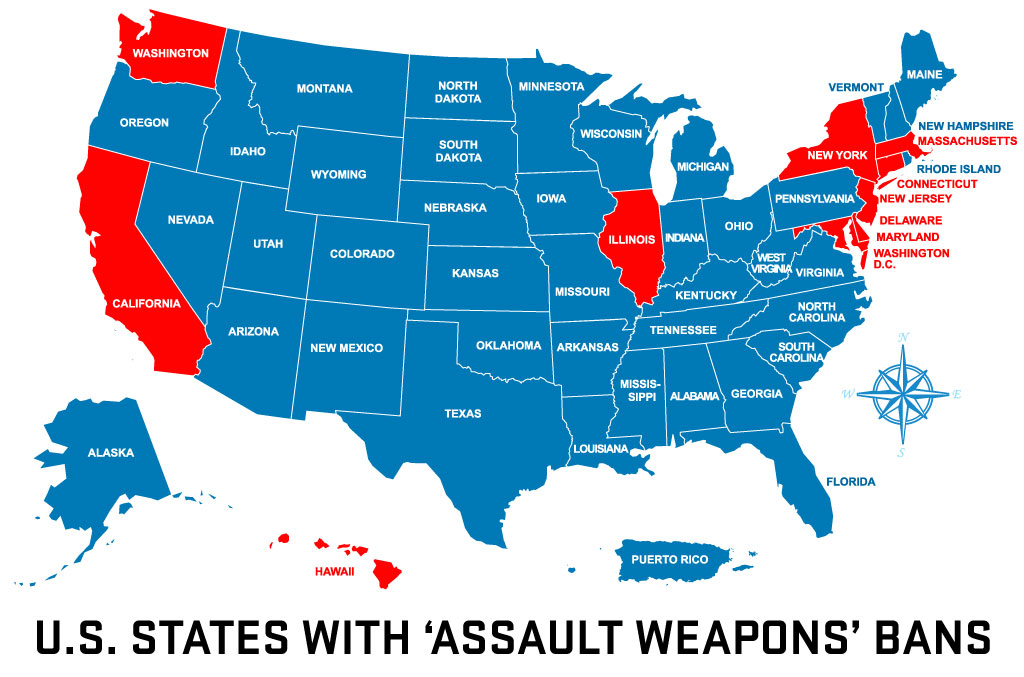
Current state-level bans
As of late 2026, a handful of states have enacted their own assault weapons bans, with varying degrees of stringency. California, Connecticut, Hawaii, Maryland, Massachusetts, New Jersey, and New York all have comprehensive bans in place, prohibiting the sale and possession of specific types of semi-automatic firearms.
California’s ban, for example, is one of the most extensive. It prohibits the manufacture, sale, transfer, and possession of certain semi-automatic rifles and shotguns, as well as large-capacity magazines. New York’s law, the New York Secure Ammunition and Firearms Enforcement (SAFE) Act, similarly restricts the sale of assault weapons and requires a 10-round magazine limit. Massachusetts has a similarly broad ban, focusing on features and specific models.
Other states, like Connecticut and Maryland, have partial bans or restrictions. Connecticut’s law focuses on specific features, such as pistol grips and adjustable stocks, while Maryland’s law prohibits certain models and features but allows for some exceptions. These states often require permits and background checks for all firearm sales, adding another layer of regulation.
A significant number of states, however, have no significant restrictions on assault weapons. These states generally allow the sale and possession of semi-automatic rifles and large-capacity magazines. The legal landscape is constantly evolving, and states are continually adjusting their gun control laws. Enforcement also varies widely, with some states actively pursuing violations and others taking a more hands-off approach.
Assault Weapons Ban States 2026: Prohibited Firearms and Magazine Restrictions
| State | Existing Ban (Y/N) | Ban Type (Comprehensive/Partial/None) | Magazine Capacity Limit | Key Legislation |
|---|---|---|---|---|
| California | Y | Comprehensive | 10 rounds | California Penal Code sections 30510-30512 |
| Connecticut | Y | Comprehensive | 10 rounds | Connecticut Public Act 13-3 (2013) |
| Hawaii | Y | Partial | 10 rounds | Hawaii Revised Statutes § 134-8 |
| Maryland | Y | Comprehensive | 10 rounds | Maryland Public Safety Act of 2013 |
| Massachusetts | Y | Comprehensive | 10 rounds | Massachusetts General Laws Chapter 140, Section 131L |
| New Jersey | Y | Comprehensive | 10 rounds | New Jersey Statute 2C:39-1 |
| New York | Y | Comprehensive | 10 rounds | New York Penal Law Article 265.00 |
| Washington | Y | Partial | 10 rounds | Revised Code of Washington 9.41.020 |
Illustrative comparison based on the article research brief. Verify current pricing, limits, and product details in the official docs before relying on it.
States Likely to Adopt Bans in 2026
Several states are being watched closely for potential new or stricter assault weapons bans in 2026. States where Democrats control both the governorship and legislature – such as Colorado, Illinois, Michigan, and Nevada – are the most likely candidates. These states have already demonstrated a willingness to consider and pass gun control legislation.
Illinois, in particular, passed a significant ban in early 2023, and further restrictions are possible. Michigan, with a newly Democratic-controlled legislature, is also actively discussing gun safety measures. Colorado has seen increased pressure from gun control advocacy groups, and the governor has expressed support for stricter regulations. Nevada could follow suit, particularly given the state's proximity to California and its history of gun violence.
States bordering those with existing bans are also worth monitoring. For example, Pennsylvania and Wisconsin, while not currently controlled by Democrats, could see renewed debate on assault weapons bans if neighboring states continue to tighten their regulations. The spillover effect – concerns about firearms being trafficked from less restrictive states – often drives legislative action.
It's important to note that legislative outcomes are never guaranteed. Political dynamics can shift quickly, and even in states with supportive legislatures, strong opposition from gun rights groups can create significant obstacles. However, the current trend suggests that more states will likely consider and potentially enact assault weapons bans in the coming year.
Potential Ban States - 2026
- Colorado - Following the Club Q shooting in 2022, Colorado passed a ban on certain assault weapons, but legal challenges have created uncertainty. Continued legislative efforts and potential favorable rulings could lead to a more comprehensive and durable ban by 2026, particularly with ongoing advocacy from gun control groups.
- Maryland - Maryland already has restrictions on assault weapons, but recent court decisions have narrowed the scope of the ban. Expect renewed legislative attempts to broaden the definition of prohibited firearms and reinforce existing restrictions, making it a likely candidate for further tightening of regulations by 2026.
- New York - New York has some of the strictest gun laws in the nation, and has previously enacted and then seen portions of its assault weapons ban struck down. Given the state’s political climate and history of responding to gun violence, further legislative action to re-establish and potentially expand the ban is highly probable by 2026.
- Washington - Washington State has seen increasing pressure to address gun violence, and while previous attempts at a full ban have stalled, the political momentum continues. A combination of public demand and legislative support suggests a strong possibility of a more comprehensive assault weapons ban being enacted by 2026.
- Minnesota - With a Democratic trifecta (governor and both legislative chambers), Minnesota is positioned to further strengthen its gun laws. Following recent expansions of background checks, a push for an assault weapons ban is anticipated, potentially succeeding by 2026 given the current political landscape.
- Illinois - Illinois already has an assault weapons ban in place, but it faces ongoing legal challenges. The state's strong support for gun control, coupled with the potential for court decisions upholding the ban, makes it likely that the existing restrictions will remain and potentially be expanded by 2026.
- Michigan - Michigan recently enacted universal background checks and red flag laws, signaling a shift towards stricter gun control. With continued advocacy from gun safety organizations and a Democratic-controlled legislature, a debate and potential enactment of an assault weapons ban is plausible by 2026.
How states define assault weapons
One of the most significant challenges in understanding assault weapons bans is the lack of a consistent definition of 'assault weapon' across states. California, for instance, relies heavily on a list of prohibited firearms, specifying models by name and focusing on detachable magazines. Their definition is quite broad, encompassing a wide range of semi-automatic rifles.
New York’s SAFE Act, while also listing prohibited firearms, places greater emphasis on specific features like pistol grips, folding or telescoping stocks, and flash suppressors. Connecticut’s law is similar, focusing on firearms with two or more of these military-style features. These feature-based definitions can be subjective and open to interpretation.
Maryland’s approach is a hybrid, prohibiting specific models and firearms with certain features. This creates a complex regulatory environment, where a firearm legal in one county might be illegal in another. Hawaii’s ban is also feature-based but includes a broader range of prohibited features.
The variation in definitions has significant implications. A firearm that complies with the law in Texas, for example, could be considered an illegal assault weapon in California. This creates confusion for gun owners and challenges for law enforcement. It also fuels legal challenges, with opponents arguing that the definitions are overly broad and violate Second Amendment rights. A simple checklist of features doesn’t always clarify the legal status of a firearm.
- Detachable magazines that allow for quick reloading.
- Pistol Grip: A grip that resembles that found on a pistol.
- Adjustable Stock: A stock that can be adjusted to fit the shooter's size.
- Flash Suppressor: A device that reduces the flash from the muzzle.
- Threaded Barrel: A barrel that is threaded to accept attachments.
Magazine capacity limits by state
Magazine capacity restrictions are a common component of assault weapons bans and broader gun control legislation. California, Colorado, Connecticut, Hawaii, Maryland, Massachusetts, New Jersey, New York, Vermont, and Washington D.C. all limit magazine capacity to 10 rounds.
These laws typically prohibit the possession of magazines that can hold more than 10 rounds. Some states, like California and New York, have implemented buyback programs to encourage residents to surrender high-capacity magazines. Penalties for possessing illegal magazines vary, ranging from fines to criminal charges.
However, these laws are not without their challenges. Opponents argue that they infringe on Second Amendment rights and do not effectively reduce gun violence. Several lawsuits have been filed challenging the constitutionality of magazine capacity restrictions, with varying degrees of success. Some courts have upheld the laws, while others have struck them down.
Grandfathering clauses for magazines purchased before the ban are rare. In states with strict bans, possessing a high-capacity magazine, even if legally purchased previously, can result in prosecution. The enforcement of these laws is often uneven, and it can be difficult for law enforcement to track and confiscate illegal magazines.
- California limits magazines to 10 rounds.
- Colorado: 15-round limit.
- Connecticut: 10-round limit.
- Hawaii: 10-round limit.
- Maryland: 10-round limit.
Legal Challenges and Future Outlook
Assault weapons bans are consistently challenged in court, primarily on Second Amendment grounds. Opponents argue that these bans violate the right to bear arms, as protected by the Second Amendment. The Supreme Court has not directly addressed the constitutionality of assault weapons bans, leaving the issue to lower courts.
Recent legal challenges have focused on arguments that assault weapons are 'common use' firearms, and therefore protected by the Second Amendment. The New York State Rifle & Pistol Association, Inc. v. Bruen decision in 2022 has significantly impacted these cases, requiring courts to consider historical precedent when evaluating gun control laws. This has led to some bans being temporarily blocked or overturned.
The future of gun control legislation at the state and federal levels remains uncertain. While Democrats generally favor stricter gun laws, Republicans tend to oppose them. The political landscape is constantly shifting, and legislative outcomes are difficult to predict. The outcome of the 2024 elections will likely play a significant role in shaping the future of gun control.
I believe we'll continue to see a patchwork of gun laws across the country, with some states enacting stricter regulations and others resisting them. The legal battles over these laws will likely continue for years to come. It's a deeply divisive issue, and finding common ground will be a significant challenge.
Do you believe stricter assault weapons bans will become more common across U.S. states in the next 5 years?
As more states consider legislation on prohibited firearms and magazine capacity restrictions, we want to hear from our readers. Based on current legislative trends and your understanding of gun laws, what do you think the future holds? Vote below and share your perspective!
No comments yet. Be the first to share your thoughts!