

Red Flag Laws: A Rapidly Changing Map
Red flag laws, or Extreme Risk Protection Orders (ERPOs), are a part of the gun control debate in the United States. They aim to temporarily remove firearms from individuals deemed a danger to themselves or others through a court order, with the goal of preventing violence.
The number of states enacting these laws has grown rapidly, creating a patchwork of regulations. As of late 2026, over twenty states have some form of red flag legislation. Proponents argue they are a tool for preventing mass shootings and suicides, while opponents raise concerns about due process and potential abuses.
This article overviews red flag laws as they stand in 2026, detailing which states have adopted them, how they function, key differences between state laws, and ongoing legal challenges. Understanding these laws is important for gun owners and those concerned about public safety.
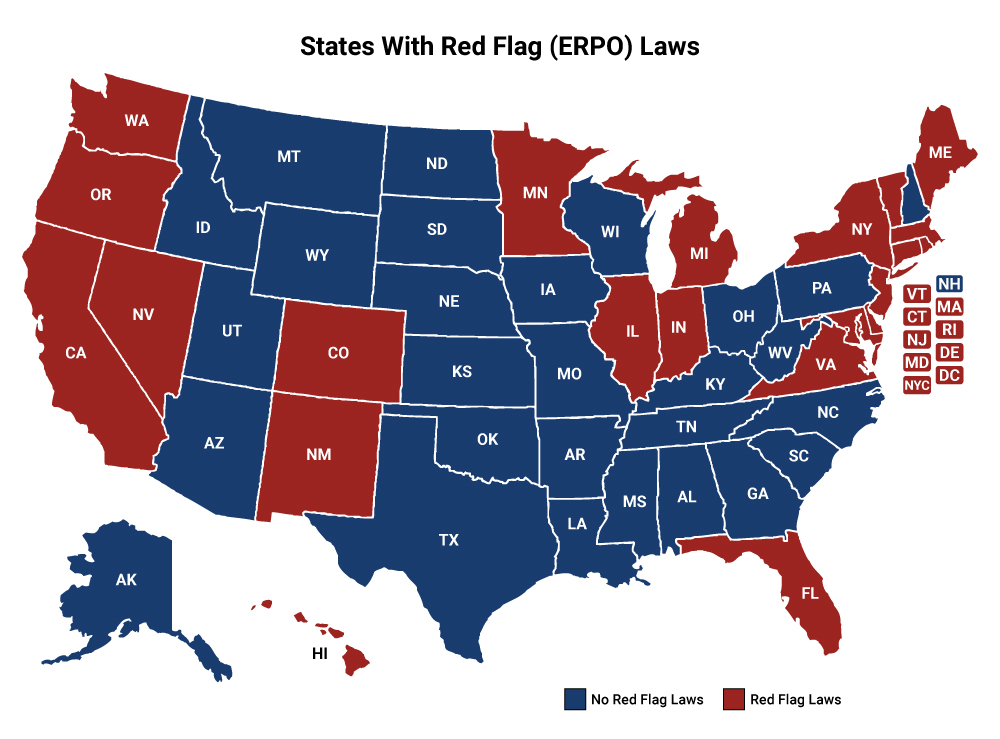
Which States Have ERPOs Now?
As of December 2026, a significant number of states have enacted some form of Extreme Risk Protection Order (ERPO) law, according to data from the Institute for Firearm Injury Prevention at the University of Michigan and World Population Review. The specifics of these laws vary considerably from state to state.
Currently, states with full ERPO laws – meaning both law enforcement and private citizens (typically family members) can petition for an order – include California, Colorado, Connecticut, Delaware, Florida, Hawaii, Illinois, Maryland, Massachusetts, New Jersey, New Mexico, New York, Oregon, Rhode Island, Vermont, Washington, and the District of Columbia. These states generally have more robust procedures for implementing and enforcing ERPOs.
A smaller group of states have limited ERPO laws, where only law enforcement can petition for an order. These include Indiana, Nevada, and Texas. These laws are often narrower in scope and may have stricter requirements for obtaining an order. Several states, like Arizona, have passed legislation authorizing ERPOs but implementation has been delayed or challenged.
Notably, a substantial number of states still have no red flag laws on the books. This includes many states in the South and Midwest, where there is often stronger opposition to gun control measures. The legislative landscape is constantly shifting, so this information is subject to change. It’s always best to consult state-specific resources for the most up-to-date information.
- Full ERPO: California, Colorado, Connecticut, Delaware, Florida, Hawaii, Illinois, Maryland, Massachusetts, New Jersey, New Mexico, New York, Oregon, Rhode Island, Vermont, Washington, District of Columbia
- Limited ERPO: Indiana, Nevada, Texas
- No Law: Alabama, Alaska, Arkansas, Georgia, Idaho, Kansas, Kentucky, Louisiana, Maine, Mississippi, Missouri, Montana, Nebraska, North Carolina, North Dakota, Oklahoma, Pennsylvania, South Carolina, South Dakota, Tennessee, Utah, Virginia, West Virginia, Wisconsin, Wyoming
State Extreme Risk Protection Order (ERPO) Status - 2026
| State | ERPO Status | Petitioners | Standard of Evidence | Firearm Removal Duration |
|---|---|---|---|---|
| California | Full | Law enforcement, immediate family members | Substantial probability of danger to self or others | Up to one year, renewable |
| Florida | Full | Law enforcement, family members, school administrators | Clear and convincing evidence of present danger | Up to one year, renewable |
| Illinois | Full | Law enforcement, family/household members | Clear and present danger | Up to six months, renewable |
| Maryland | Full | Law enforcement, qualifying family members | Reasonable expectation of imminent harm | Up to one year, renewable |
| Colorado | Full | Law enforcement, family/household members | Credible evidence that the respondent poses a significant risk | Up to one year, renewable |
| New York | Full | Law enforcement, family/household members | Clear and convincing evidence of dangerous behavior | Up to one year, renewable |
| Washington | Full | Law enforcement, family/household members | Probable cause to believe respondent presents a danger | Up to one year, renewable |
| Indiana | Limited | Law enforcement only | Reasonable suspicion | Temporary, pending court hearing |
Qualitative comparison based on the article research brief. Confirm current product details in the official docs before making implementation choices.
How Do These Laws Actually Work?
Obtaining an ERPO begins with a petition filed with a state court. In states where private citizens can petition, this is often a family member, household member, or someone with a close relationship to the individual. Law enforcement can also initiate the process, based on observations or reports of concerning behavior.
The petition must present evidence that the individual poses a significant risk of harm to themselves or others. Evidence can include threats of violence, recent acts of violence, possession of firearms during a mental health crisis, or a history of domestic abuse. The standard of evidence required varies by state but is typically lower than the standard for a criminal conviction.
Following the petition, a temporary hearing is usually scheduled within a few days. At this hearing, a judge reviews the evidence and determines whether there is probable cause to issue a temporary ERPO. If granted, the order typically lasts for 14 to 21 days, during which time the individual is prohibited from possessing firearms and must surrender any they possess.
The individual subject to the temporary ERPO can challenge the order in a full evidentiary hearing. This hearing functions like a civil trial, with both sides presenting evidence and witnesses. The standard of proof at this hearing is often higher than at the temporary hearing, sometimes requiring clear and convincing evidence. If the judge finds the individual still poses a significant risk, they can issue a final ERPO, which can last for up to a year or more, depending on the state.
Variations in State Laws: Key Differences
While the core concept of red flag laws is consistent, their implementation varies significantly across states. One key difference is who can petition the court for an ERPO. Some states allow only law enforcement to file petitions, while others extend this right to family members, household members, or even school administrators.
The standard of evidence required to obtain an order also varies. Some states require 'probable cause,' meaning a reasonable belief that the individual poses a threat. Others require a higher standard, such as 'clear and convincing evidence,' which is more demanding. This difference can significantly impact the likelihood of obtaining an order.
The duration of temporary and final ERPOs also differs. Temporary orders typically last between 14 and 21 days, but final orders can range from several months to a year or longer. Some states specify procedures for renewing an ERPO if the risk persists beyond the initial order period.
Finally, due process protections vary. Some states provide respondents with the right to legal counsel at the temporary hearing, while others do not. The availability of appointed counsel, the opportunity to present evidence, and the procedures for appealing a decision can all differ significantly from state to state. These variations are a source of ongoing debate and legal challenges.
Due Process and Legal Challenges
Red flag laws have faced legal challenges, primarily concerning Second Amendment rights and due process. Opponents argue these laws violate the right to bear arms by allowing firearm seizure before an individual has been convicted of a crime.
Due process concerns are also prominent. Critics argue individuals subject to ERPOs may not receive adequate notice or an opportunity to be heard before their firearms are seized. They contend that the temporary nature of hearings and lack of guaranteed legal counsel can deprive individuals of constitutional rights.
As of late 2026, there haven’t been definitive Supreme Court rulings on the constitutionality of red flag laws. However, several lower courts have upheld these laws, finding they do not violate the Second Amendment as long as they include adequate due process protections. Courts generally emphasize the government's interest in preventing gun violence and protecting public safety.
The legal landscape is constantly evolving, and future court cases could significantly alter the interpretation and application of red flag laws. Arguments will likely continue to revolve around balancing individual rights with the need to prevent gun violence.
Federal Action and the Preventing Unjust Red Flag Laws Act
Recognizing the growing prevalence of red flag laws, Congress has considered federal legislation. The Preventing Unjust Red Flag Laws Act
Key provisions of the bill included requirements for clear and convincing evidence at both the temporary and final hearing stages, the appointment of legal counsel for respondents who cannot afford it, and provisions to ensure that individuals have a meaningful opportunity to challenge the order. It also sought to incentivize states to adopt due process protections.
As of December 2026, the bill has faced significant opposition and has not been passed by Congress. Republicans have expressed concerns about potential abuses and the infringement on Second Amendment rights, while Democrats have generally supported the bill as a way to enhance public safety. The bill's future remains uncertain.
Even without federal legislation, the Preventing Unjust Red Flag Laws Act has spurred discussion and prompted some states to re-evaluate their existing laws to ensure they include adequate due process protections. The debate at the federal level underscores the ongoing national conversation about gun control and the role of red flag laws.
Looking Ahead: Trends and Predictions
The trend towards adopting red flag laws is likely to continue in the coming years, although the pace of adoption may slow as more states grapple with legal challenges and political opposition. We can anticipate further refinement of existing laws as states attempt to address due process concerns and balance the rights of individuals with public safety considerations.
I suspect we’ll see increased efforts to standardize ERPO procedures across states, potentially through federal incentives or guidance. The focus will likely be on ensuring that all laws include robust due process protections, such as appointed counsel and a meaningful opportunity to be heard.
Legal challenges will undoubtedly persist. Expect to see more cases working their way through the courts, potentially leading to a Supreme Court ruling on the constitutionality of these laws. The outcome of these cases will have a significant impact on the future of red flag legislation.
Ultimately, the success of red flag laws will depend on their ability to effectively prevent gun violence while respecting the constitutional rights of individuals. Finding that balance will be a key challenge in the years ahead. The conversation around these laws is complex and will continue to evolve.

No comments yet. Be the first to share your thoughts!