

Red flag laws at a glance
Red flag laws allow courts to temporarily take guns away from people who show signs they might hurt themselves or others. The goal is to step in before someone pulls a trigger, creating a mandatory cooling-off period while a judge looks at the evidence.
The legal basis for these laws rests on the concept of due process, though the specifics vary widely by state. Proponents argue that red flag laws save lives by preventing suicides and mass shootings, while opponents raise serious concerns about infringing on Second Amendment rights and the potential for abuse. It’s a complex issue with passionate arguments on both sides.
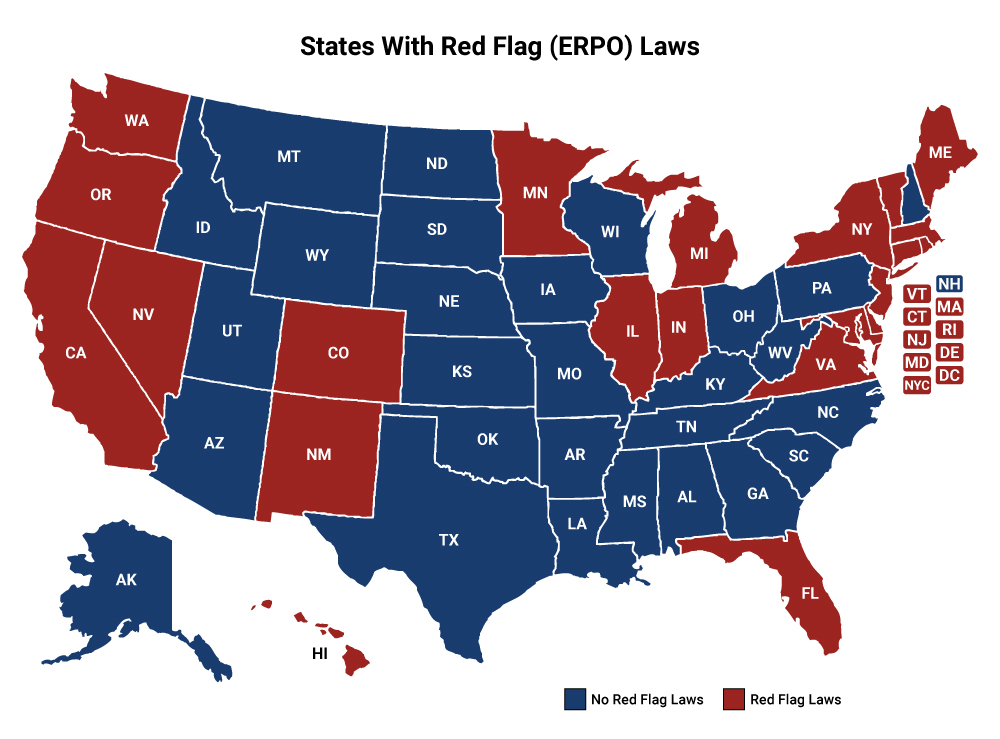
The rules vary wildly depending on which state line you're standing behind. Here is how the map looks in 2026.
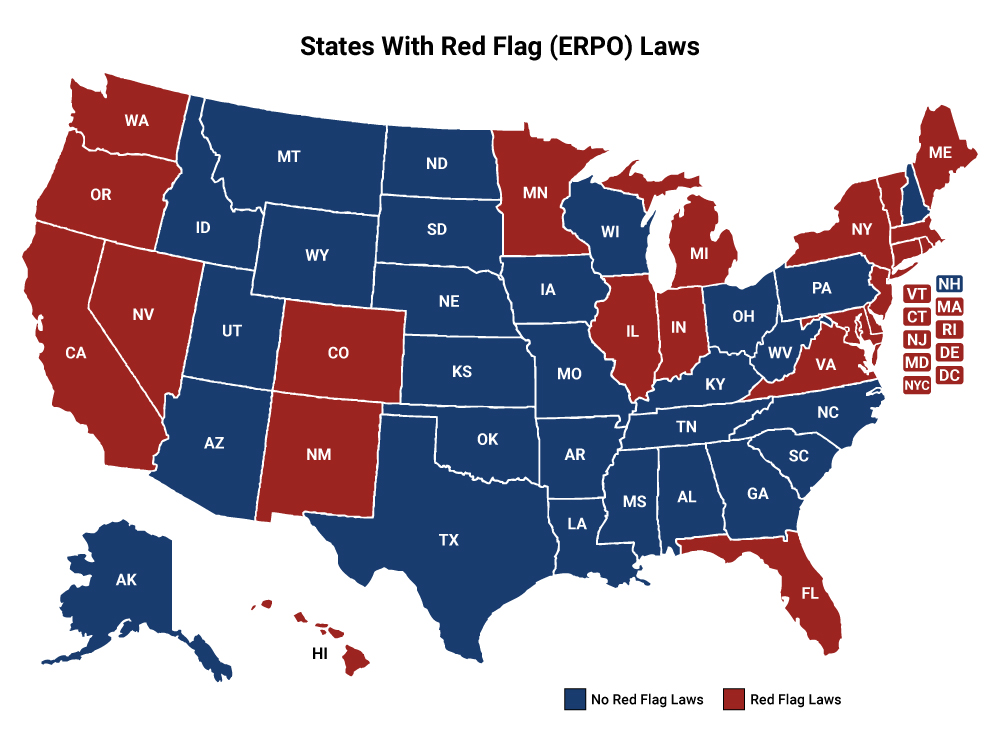
States with active laws in 2026
As of February 2026, 21 states and the District of Columbia have enacted some form of red flag law, officially known as Extreme Risk Protection Orders. However, the scope and specifics of these laws differ considerably. Some states have comprehensive ERPO laws, while others have more limited versions with specific restrictions. Several states are currently considering legislation to either enact or repeal these laws.
Here's a state-by-state look (this is not exhaustive, and laws are subject to change): California has a robust ERPO law allowing law enforcement, family members, and employers to petition for an order. The standard of evidence is "reasonable suspicion" and orders can last up to one year. Colorado's law, enacted in 2019, allows law enforcement and family members to petition. Connecticut’s law, passed in 1999, initially focused on restraining orders but has been expanded to include ERPOs. Delaware allows law enforcement, family members, and healthcare providers to petition.
Florida's law, passed after the Parkland shooting, is notable for including firearms dealers in who can petition. Hawaii has had a version of a red flag law since 2004. Illinois expanded its law in 2022, allowing for broader categories of petitioners. Indiana’s law, enacted in 2022, is considered more restrictive, focusing primarily on situations involving domestic violence. Maryland allows law enforcement and family members to petition, with a focus on preventing suicide. Massachusetts has a law allowing family or household members to petition.
New Jersey's law allows law enforcement and family members to petition. New Mexico's law allows law enforcement, family members, and healthcare providers to petition. New York’s law allows law enforcement, school officials, and family members to petition. Oregon has a law allowing law enforcement to petition. Rhode Island allows law enforcement and family members to petition. Vermont’s law is limited to situations involving domestic violence. Virginia’s law allows law enforcement and family members to petition. Washington state’s law allows law enforcement and family members to petition.
Wisconsin’s law allows law enforcement to petition. The District of Columbia also has an ERPO law in effect. Several other states, including North Carolina and Texas, have seen legislative attempts to enact red flag laws, but these have faced significant opposition and have not yet been successful. The level of due process protection varies. Some states require a full hearing before an order is issued, while others allow for temporary orders based on less evidence.
These rules change fast. A law in Florida doesn't look like a law in Oregon, and court challenges frequently shift what is actually enforceable on the ground.
- California: Allows law enforcement, family members, and employers to petition.
- Colorado: Law enforcement and family members can petition.
- Florida: Includes firearms dealers among those who can report concerns.
Extreme Risk Protection Orders (ERPO) – State Status (2026)
| State | ERPO Law? | Petitioners | Evidence Standard | Order Duration | Due Process Protections |
|---|---|---|---|---|---|
| California | Yes | Law Enforcement, Family/Household Members | Probable Cause | Up to 1 year, renewable | Hearing within 14 days, appointed counsel for respondent |
| Colorado | Yes | Law Enforcement, Family/Household Members | Reasonable Cause | Up to 365 days | Hearing within 14 days, respondent rights to notice and counsel |
| Connecticut | Yes | Law Enforcement | Probable Cause | Up to 1 year | Hearing within 14 days, respondent has right to counsel |
| Delaware | Yes | Law Enforcement, Qualified Healthcare Professionals | Reasonable Suspicion | Up to 6 months, renewable | Hearing within 7 days, respondent right to counsel |
| Florida | Yes | Law Enforcement | Probable Cause | Up to 2 years | Hearing within 14 days, respondent right to counsel |
| Hawaii | Yes | Law Enforcement, Family/Household Members | Reasonable Cause | Up to 1 year | Hearing within 10 days, respondent right to counsel |
| Illinois | Yes | Law Enforcement, Family/Household Members | Clear and Convincing Evidence | Up to 6 months, renewable | Hearing within 21 days, respondent right to counsel |
| Indiana | No | N/A | N/A | N/A | N/A |
| Maryland | Yes | Law Enforcement, Family/Household Members | Probable Cause | Up to 6 months, renewable | Hearing within 7 days, respondent right to counsel |
| Massachusetts | Yes | Law Enforcement | Reasonable Cause | Up to 1 year, renewable | Hearing within 10 days, respondent right to counsel |
Illustrative comparison based on the article research brief. Verify current pricing, limits, and product details in the official docs before relying on it.
How the rules differ by state
Despite the common goal of preventing gun violence, red flag laws vary significantly in their key provisions. One major difference lies in who is authorized to petition for an ERPO. Most states allow law enforcement to petition, but the inclusion of family members, household members, educators, and healthcare providers varies considerably. Some states even allow employers or firearms dealers to initiate the process.
The "burden of proof’ required to obtain an ERPO is another critical distinction. Some states require ‘probable cause,’ meaning a reasonable belief that the individual poses a danger. Others use a lower standard, such as ‘reasonable suspicion’ or ‘credible evidence." This difference impacts how easily an order can be obtained and the level of evidence needed to convince a judge. The length of initial orders also varies, ranging from a few days to several weeks.
Renewal processes are also distinct. Initial orders typically require a full hearing where the individual has the opportunity to present a defense. Renewal orders often have a lower standard of evidence, but still require a hearing. Some states limit the total duration of an ERPO, while others allow for indefinite renewals as long as the individual continues to be deemed a risk. These variations are important to understand when comparing laws across states. I'm seeing a lot of states grappling with balancing safety concerns against due process rights.
Legal fights and due process
Red flag laws have faced numerous legal challenges, primarily centered on concerns about due process rights guaranteed by the Second and Fourteenth Amendments to the US Constitution. Opponents argue that these laws allow for the seizure of firearms before an individual has been convicted of a crime, violating their right to bear arms and their right to a fair legal process.
The core due process concerns include the lack of notice to the individual before their firearms are seized, the limited opportunity to be heard in court, and the difficulty in confronting accusers. Critics argue that these laws create a system where individuals can be deprived of their constitutional rights based on unsubstantiated allegations. The Supreme Court case Voisine v. United States (2016) dealt with domestic violence and firearm possession, but its principles are often raised in challenges to red flag laws.
Several state-level rulings have also addressed the constitutionality of these laws. Some courts have upheld the laws, finding that they provide sufficient due process protections, while others have struck them down or limited their scope. For example, some rulings have emphasized the need for a more robust hearing process and a higher standard of evidence. The legal landscape is constantly shifting, and further court challenges are expected. It’s a delicate balance between public safety and individual rights, and the courts are still working through it.
The push for federal standards
Currently, there is no comprehensive federal red flag law in the United States. However, there have been several attempts to enact federal legislation to encourage or incentivize states to adopt ERPO laws. The most recent notable effort is H.R.223 - Preventing Unjust Red Flag Laws Act of 2025, introduced in the House of Representatives.
H.R.223 aims to address some of the due process concerns raised by opponents of red flag laws. It proposes establishing minimum due process standards that states must meet in order to receive federal funding related to ERPO programs. These standards include requiring a hearing within 14 days of a temporary order being issued, providing the individual with access to legal counsel, and allowing them to present evidence in their defense.
The arguments for federal involvement center on the idea that red flag laws can be an effective tool for preventing gun violence nationwide. Proponents believe that establishing minimum standards will ensure that these laws are implemented fairly and consistently across all states. Opponents argue that federal involvement would infringe on states' rights and could lead to the erosion of Second Amendment protections. The likelihood of H.R.223 passing is uncertain, given the current political climate and the strong opposition from gun rights groups. It’s a situation to watch closely.
Do these laws actually save lives?
Proving these laws work is hard. While some data suggests they help, it is difficult to prove a shooting didn't happen because of a specific court order. The University of Michigan’s Institute for Firearm Injury Prevention is still tracking the long-term numbers.
Some studies have shown a correlation between the implementation of red flag laws and a decrease in suicide rates, particularly in states with well-established ERPO programs. However, correlation does not equal causation, and other factors could be contributing to these trends. It's challenging to isolate the specific impact of red flag laws from other interventions, such as increased mental health services or changes in gun control policies.
The data on the impact of red flag laws on mass shootings is even more limited. Mass shootings are rare events, and it's difficult to determine whether an ERPO law prevented a shooting that would have otherwise occurred. The Institute for Firearm Injury Prevention acknowledges the limitations of existing data and calls for further research to better understand the effectiveness of these laws. It’s critical to avoid drawing premature conclusions based on incomplete information.
No comments yet. Be the first to share your thoughts!