

Red Flag Laws: A 2026 Snapshot
Red flag laws, officially known as Extreme Risk Protection Orders (ERPOs), are a new and debated approach to gun control in the United States. These laws allow for the temporary removal of firearms from individuals deemed a danger to themselves or others. This is a preventative measure, aiming to intervene before violence occurs.
These laws balance public safety with individual due process rights. Supporters argue ERPOs save lives by disarming individuals in a mental health crisis or showing warning signs of violence. Opponents raise concerns about potential abuse and the violation of Second and Fourteenth Amendment rights. It's a complex issue with deeply held beliefs on both sides.
The political climate surrounding red flag laws is charged as of early 2026. The Preventing Unjust Red Flag Laws Act of 2025 (H.R.223) in Congress reflects pushback against these laws from some lawmakers. This bill, if passed, could alter ERPOs nationwide, potentially imposing stricter requirements and safeguards. Understanding the intent behind these laws and the concerns they raise is essential.
As of 2026, red flag laws are not universal. Over half the states have enacted some form of ERPO legislation, but specifics vary considerably, from robust due process protections to expedited procedures. The debate is not just whether to implement these laws, but how to do so responsibly and effectively. This conversation will continue.
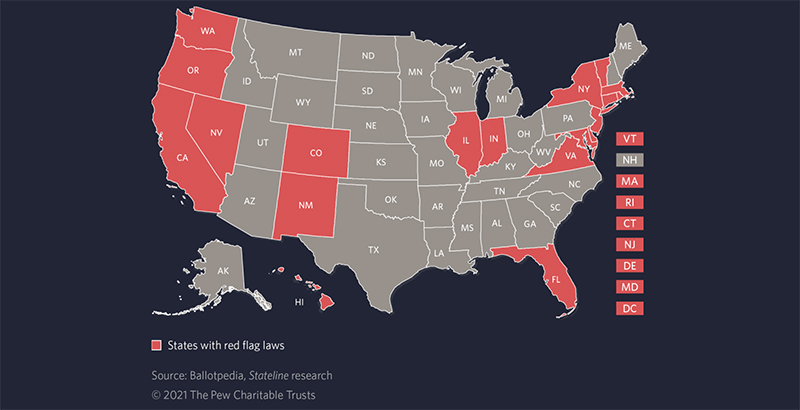
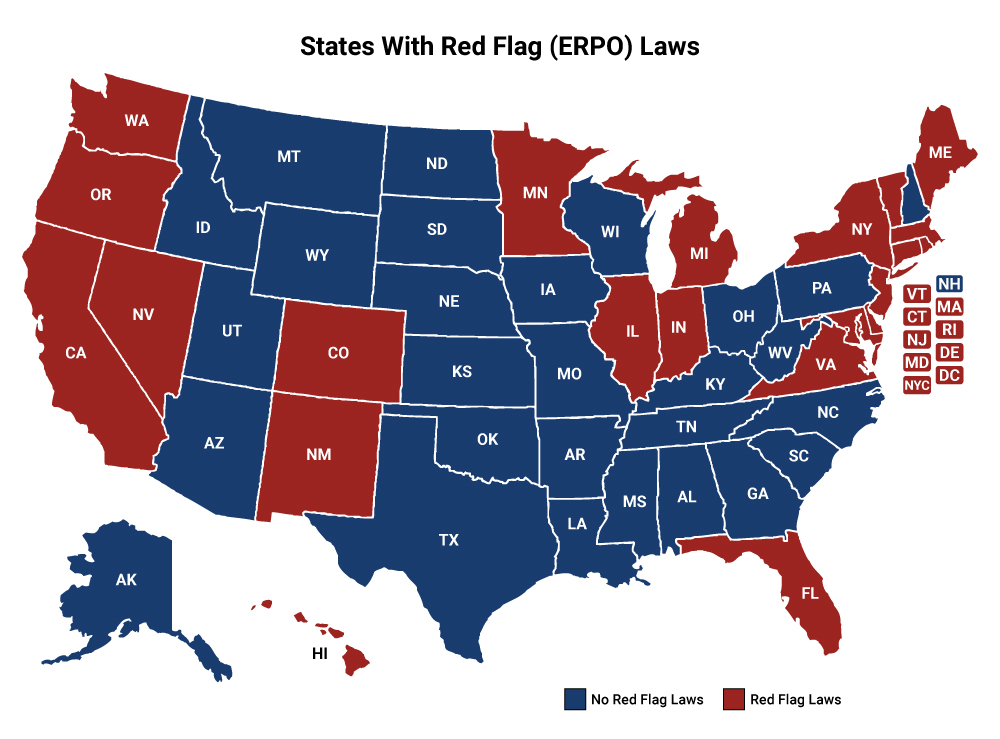
States With Current Red Flag Laws (2026)
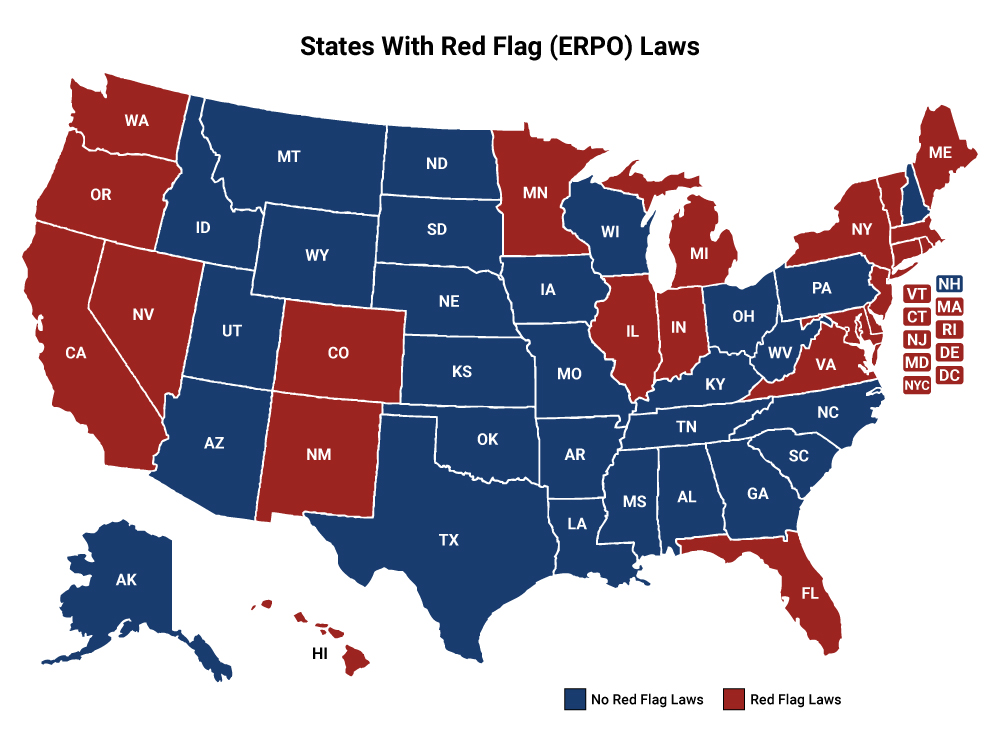
As of February 2026, 28 states and the District of Columbia have enacted some form of red flag law. The specifics of these laws differ considerably, impacting implementation and the due process afforded to individuals subject to an order. This is not a one-size-fits-all system.
Here is a snapshot of states with active red flag laws (as of early 2026). They are categorized loosely based on procedural protections, but this is a simplification; each state's law has unique nuances. California, for example, allows firearm removal based on a lower standard of evidence than some other states.
States with Red Flag Laws (as of Feb 2026): California, Colorado, Connecticut, Delaware, Florida, Hawaii, Illinois, Indiana, Maryland, Massachusetts, New Jersey, New Mexico, New York, North Carolina, Oregon, Rhode Island, Vermont, Virginia, Washington, Nevada, Arizona, Pennsylvania, Texas, Tennessee, Maine, New Hampshire, Wisconsin, and the District of Columbia.
California’s law (Penal Code sections 13684-13688) allows law enforcement, employers, school officials, and household members to petition for a Gun Violence Restraining Order (GVRO). Colorado recently expanded its law (discussed further below). Connecticut’s law emphasizes mental health evaluations and offers a pathway for individuals to regain their firearm rights after a period of time. Florida’s law, passed in the wake of the Parkland shooting, has been subject to numerous legal challenges. These are just a few examples; each state’s approach is distinct.
State Extreme Risk Protection Order (ERPO) Laws - 2026
| State | Law Name (if applicable) | Year Enacted | Key Features | Due Process Level |
|---|---|---|---|---|
| California | Gun Violence Restraining Order (GVRO) | 2016 | Allows temporary removal of firearms from individuals deemed a danger to themselves or others, based on petition to court. Includes family member, household member, or law enforcement petitions. | Medium |
| Colorado | Extreme Risk Protection Order Act | 2019 | Expanded in 2026 to include a wider range of petitioners and clarify procedures for firearm removal and return. Focuses on preventing mass shootings and suicide. | Medium |
| Connecticut | Risk Warrant | 2019 | Permits law enforcement to petition for a warrant to temporarily remove firearms from individuals who pose an imminent danger. Requires a hearing. | Medium |
| Delaware | Extreme Risk Protection Order | 2020 | Allows police or qualified family/household members to petition the court for temporary removal of firearms. Includes provisions for mental health evaluation. | Medium |
| Florida | Risk Protection Order | 2018 | Allows law enforcement to petition for a Risk Protection Order based on probable cause. Includes a hearing with due process protections. | Medium |
| Illinois | Extreme Risk Protection Order | 2022 | Allows family or household members, and law enforcement, to petition for an order to temporarily remove firearms. Requires a court hearing. | Medium |
| Maryland | Extreme Risk Protective Order | 2018 | Allows law enforcement and family members to petition for temporary removal of firearms. Includes a process for firearm return after a period. | Medium |
| New Jersey | Extreme Risk Protection Order | 2022 | Allows law enforcement and certain family members to petition for temporary removal of firearms from individuals deemed a threat. Includes mental health evaluation requirements. | Medium |
Illustrative comparison based on the article research brief. Verify current pricing, limits, and product details in the official docs before relying on it.
How an ERPO Case Typically Unfolds
Obtaining an ERPO begins with filing a petition with a court. Who can file this petition varies by state, but generally includes law enforcement officers, family members, and sometimes healthcare professionals or school officials. The petitioner must present evidence demonstrating the individual poses a significant risk of harm to themselves or others.
A temporary or emergency order is often issued ex parte, without notice to the individual being targeted. This is a critical point of contention for opponents of red flag laws, who argue it violates due process. This temporary order allows immediate firearm removal. The standard of evidence for this initial order is usually low—a "reasonable suspicion’ or ‘credible threat" is often sufficient.
After a temporary order is issued, a full hearing must be scheduled, typically within 14-21 days, depending on the state. At this hearing, the individual subject to the order can present their defense and challenge the evidence against them. The standard of proof at this hearing is generally higher than for the temporary order—often "clear and convincing evidence."
If the court finds, based on the evidence, that the individual continues to pose a significant risk, a full ERPO can be issued, typically lasting six months to one year. Many laws include provisions for renewal, requiring another hearing to determine if the order should be extended. Individuals subject to an ERPO often have the right to appeal the decision.
Colorado's Expanded Red Flag Law (2026)
Colorado’s "red flag" law expanded in early 2026, as reported by The Aspen Times. The bill, which recently passed the state Senate and is heading to the House, broadens the criteria for issuing an Extreme Risk Protection Order. Previously, the law focused on individuals exhibiting immediate threats of violence.
The expansion now includes individuals deemed a danger to themselves or others based on a pattern of concerning behavior, even if there isn’t an immediate threat. This could include documented instances of domestic violence, credible threats of suicide, or a history of erratic and potentially dangerous behavior. This is a key shift – it moves beyond reacting to immediate crises to proactively addressing potential risks.
Critics of the expansion argue it lowers the threshold for firearm removal and raises due process concerns. They worry individuals could be disarmed based on less concrete evidence, potentially violating their Second Amendment rights. Supporters contend the expanded law will save lives by allowing authorities to intervene before a tragedy occurs. The debate centers on where to draw the line between public safety and individual liberty.
The new law includes provisions for mental health evaluations and support services for individuals subject to an ERPO. This recognizes the importance of addressing the underlying issues that may contribute to the individual’s risk. However, the effectiveness of these services remains to be seen.
Due Process Concerns and Legal Challenges
Consistent criticisms of red flag laws revolve around due process concerns. Opponents argue these laws allow firearm seizure before an individual has been convicted of a crime, violating their right to due process under the Fourteenth Amendment. The ex parte nature of the initial order – issued without the individual present – is a contentious point.
The Second Amendment is frequently invoked in challenges to red flag laws. Critics argue these laws infringe on the right to keep and bear arms, particularly for law-abiding citizens not found guilty of wrongdoing. They contend firearm seizure based on speculative predictions of future behavior violates this fundamental right. There's a debate about whether these laws represent
Numerous legal challenges to red flag laws are currently underway in various states. These challenges typically focus on the constitutionality of the ex parte procedures, the standard of proof required for issuing an ERPO, and the lack of adequate procedural safeguards for individuals subject to the orders. Some courts have upheld the laws, finding that they are a reasonable exercise of state power to protect public safety.
A key question in these legal battles is what level of due process is required when a fundamental right, like the right to bear arms, is potentially being infringed upon. Advocates for stricter due process protections argue that a higher standard of proof – such as "beyond a reasonable doubt" – should be required before firearms can be seized. Others argue that a lower standard is sufficient, given the urgent need to prevent gun violence.
The Federal Response: H.R.223
The Preventing Unjust Red Flag Laws Act of 2025 (H.R.223) represents a significant attempt to address concerns surrounding red flag laws at the federal level. Introduced in Congress, this bill aims to establish minimum due process standards for states that choose to enact or maintain ERPO laws. It doesn’t ban red flag laws outright; instead, it seeks to regulate them.
Key provisions of H.R.223 include requirements for a hearing to be held within 14 days of the issuance of a temporary order, the right to legal counsel for the individual subject to the order, and a requirement that the standard of proof for a full ERPO be "clear and convincing evidence." The bill also aims to ensure that individuals have a meaningful opportunity to challenge the evidence against them and present their own case.
Proponents of H.R.223 argue that it will help to safeguard the due process rights of individuals while still allowing states to utilize red flag laws as a tool for preventing gun violence. They believe that establishing federal standards will ensure that these laws are applied fairly and consistently across the country. Opponents, however, contend that the bill is a federal overreach into state affairs and that it will make it more difficult for states to effectively address the threat of gun violence.
The ultimate fate of H.R.223 remains uncertain. Its passage would likely have a significant impact on the landscape of red flag laws, potentially forcing states to amend their existing laws to comply with the federal standards. Even if it doesn't pass, the debate surrounding the bill highlights the ongoing tension between gun control and individual rights.
Looking Ahead: Trends and Predictions
Several trends are shaping the future of red flag legislation. First, we’re likely to see continued legal challenges to these laws, particularly those that lack robust due process protections. Courts will continue to grapple with the balance between public safety and individual rights, and their decisions will have a significant impact on the legality of ERPOs.
Second, the debate over federal legislation, like H.R.223, will likely continue. Even if this particular bill doesn’t pass, the push for federal standards or guidelines for red flag laws is unlikely to disappear. The issue has gained enough political traction to remain a topic of discussion in Congress.
Third, we may see more states experimenting with different approaches to red flag laws, incorporating provisions for mental health services, peer support, and other preventative measures. The focus is shifting towards not just removing firearms, but also addressing the underlying issues that contribute to the risk of violence. Colorado's recent expansion is an example of this trend.
Finally, the political polarization surrounding gun control is likely to intensify in the coming years. This will make it even more difficult to find common ground on issues like red flag laws, but it will also underscore the importance of finding solutions that respect both public safety and individual liberties. It’s a complex problem without easy answers, and the conversation will undoubtedly continue.
No comments yet. Be the first to share your thoughts!