

Red Flag Laws: A Quick Overview
Red flag laws, formally known as Extreme Risk Protection Orders (ERPOs), are a recent addition to gun control laws in the United States. These laws aim to temporarily remove firearms from individuals deemed a significant danger to themselves or others, intervening before a violent act occurs.
The process typically begins with a petition to a court, often filed by law enforcement or family members. If the court finds probable cause, a temporary ERPO is issued, and a full hearing is scheduled. During this hearing, the individual subject to the order can present their case, facing potential loss of their Second Amendment rights.
These laws spark strong debate. Supporters emphasize the potential to save lives and prevent tragedies, while opponents raise concerns about due process, potential for abuse, and infringement on constitutional rights. It's a complex issue with passionate advocates on both sides, and the legal landscape evolves.
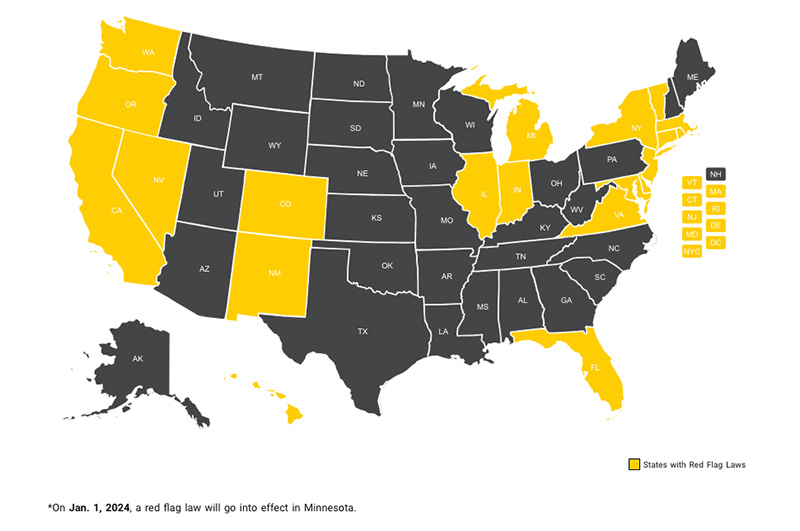
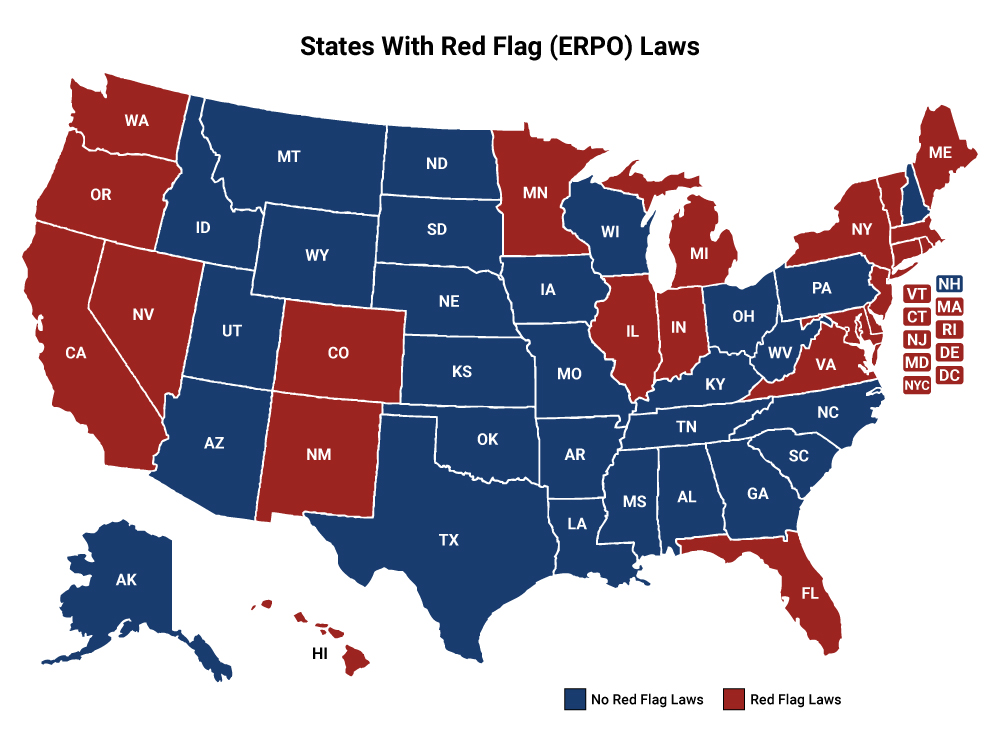
States With Active Red Flag Laws (2026)
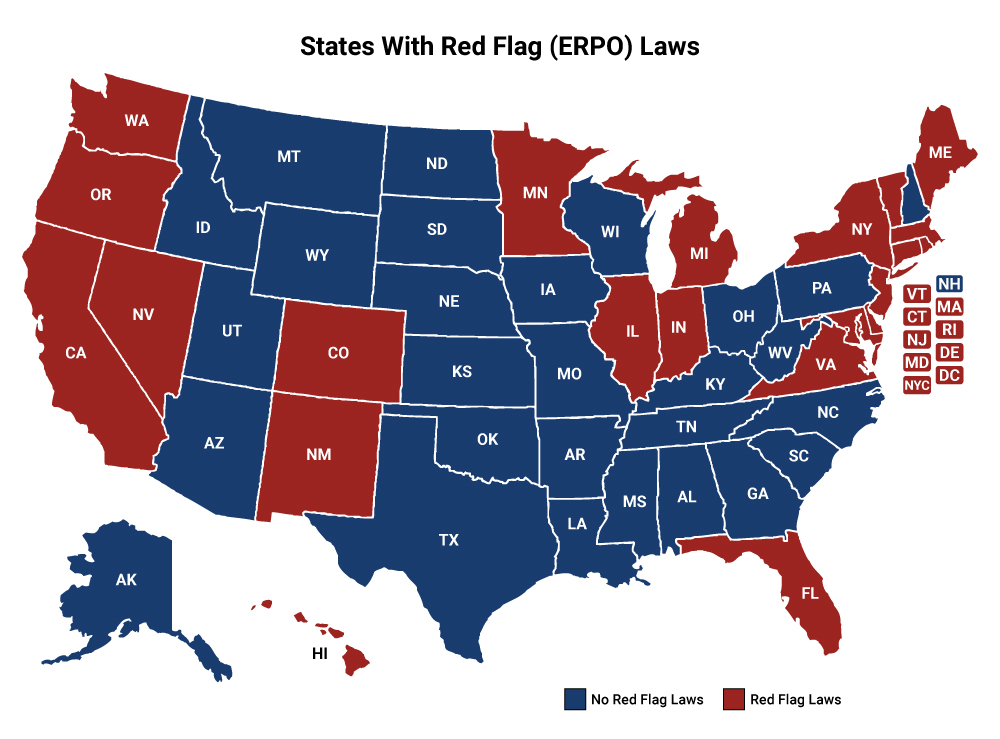
As of early 2026, the adoption of red flag laws varies across the United States. Currently, 21 states and the District of Columbia have laws allowing for the issuance of Extreme Risk Protection Orders. The specifics of these laws differ from state to state.
These states can be categorized. Some have full ERPO laws, allowing both law enforcement and family members to petition for an order. Others have limited ERPO laws, restricting petitions to law enforcement only. A number of states still have no such laws in place. The situation is dynamic, with new legislation proposed and challenged regularly.
Here’s a breakdown (data current as of February 2026, based on information from the Institute for Firearm Injury Prevention and Congress.gov):
Full ERPO: California (enacted 2015), Connecticut (2013), Delaware (2018), Florida (2018), Hawaii (2017), Illinois (2018), Maryland (2018), Massachusetts (2018), New Jersey (2018), New York (2019), Oregon (2017), Rhode Island (2018), Vermont (2018), Washington (2016), Colorado (2019), Nevada (2019), New Mexico (2019), Virginia (2020).
Limited ERPO: Indiana (2022), North Carolina (2023).
No Law: The remaining states do not currently have red flag laws in effect. This includes states like Texas, Arizona, and many in the South and Midwest. It's worth noting that legislative efforts are ongoing in many of these states to introduce similar legislation.
Extreme Risk Protection Order (ERPO) Status by State - 2026
| State | ERPO Status | Enactment Date (if applicable) | State Law/Legislation Link |
|---|---|---|---|
| California | Full | 2015 | https://leginfo.legislature.ca.gov/faces/codes_displaySection.xhtml?lawCode=WIC§ionNum=943.66 |
| Colorado | Full | 2019 | https://leg.colorado.gov/sites/default/files/crs2019_0075_signed.pdf |
| Connecticut | Full | 2013 | https://www.cga.ct.gov/2013/POF/pdf/2013POF0069.pdf |
| Delaware | Full | 2018 | https://delcode.delaware.gov/title11/c012/sc012A0501.shtml |
| Florida | Full | 2018 | http://www.leg.state.fl.us/statutes/2018/0790.015.html |
| Hawaii | Full | 2017 | https://www.capitol.hawaii.gov/hrsc/hrsc171/HRSC_Bills/HR171_HB1552_HD1_20170404_163334_1.pdf |
| Illinois | Full | 2018 | https://www.ilga.gov/legislation/ilcs/ilcs4/725ILCS5/725ILCS5.htm |
| Indiana | Limited | 2022 | https://iga.in.gov/legislative/2022session/bills/house/hb1286/ |
| Maryland | Full | 2018 | https://mga.maryland.gov/mgawebsite/Legislation/Details/HB1322?andYear=2018RS |
| Massachusetts | Full | 2018 | https://malegislature.gov/Laws/GeneralLaws/PartI/TitleXIV/Chapter140/Section131L |
| New Jersey | Full | 2018 | https://www.njleg.state.nj.us/bills/OL2018/Public/A4472.htm |
| New Mexico | Full | 2019 | https://www.nmlegis.gov/Legislation/ViewLegislation?s=19&c=02&t=HJB1 |
| New York | Full | 2019 | https://nycourts.gov/courts/problem-solving/domesticviolence/redflaglaw.shtml |
| Oregon | Full | 2017 | https://olis.oregonlegislature.gov/liz/2017R1/Downloads/MeasureDocument/HB2013 |
| Rhode Island | Full | 2018 | https://www.rilin.state.ri.us/PublicLaws/Law2018/PL18-038.pdf |
| Vermont | Full | 2018 | https://legislature.vermont.gov/bill/H.506 |
| Virginia | Full | 2020 | https://law.lis.virginia.gov/vacode/title18.2/chapter7/article2.1/ |
Illustrative comparison based on the article research brief. Verify current pricing, limits, and product details in the official docs before relying on it.
How ERPOs Work: A Step-by-Step Guide
Obtaining an ERPO generally follows a similar pattern across states, though specific details vary. It begins with a petition filed with a court. The petitioner – typically a law enforcement officer, but in many states, also family members or household members – presents evidence suggesting the individual poses a significant risk of harming themselves or others.
If the court finds the petition presents probable cause, a temporary ERPO is issued. This temporary order typically lasts for 14-21 days, depending on the state. During this period, the individual cannot possess firearms, and law enforcement may be authorized to temporarily seize any firearms they own.
A full hearing is then scheduled. This is a more formal proceeding where the individual subject to the order can present evidence and challenge the petition. The standard of proof required for a full ERPO varies, but it’s usually "clear and convincing evidence." If the court finds clear and convincing evidence that the individual poses a risk, a full ERPO can be issued, lasting from six months to a year, and potentially renewable.
- Petition Filing: Someone files a petition with the court.
- Temporary Order: If probable cause is found, a temporary ERPO is issued.
- Firearm Removal: Law enforcement may seize firearms.
- Full Hearing: A hearing is scheduled for a more thorough review.
- Final Order: If clear and convincing evidence is found, a full ERPO is issued.
Grounds for Petitioning: What Qualifies?
Grounds for petitioning an ERPO generally center around credible threats of violence. These threats can be directed towards oneself (suicidal ideation) or towards others. The focus is on demonstrable behavior suggesting an imminent risk of harm.
Examples of qualifying behaviors include making specific threats of harm, exhibiting a pattern of violent behavior, possessing firearms during a mental health crisis, or engaging in reckless gun use. The petitioner must present evidence to support these claims, such as witness statements, text messages, social media posts, or medical records.
Simply owning firearms or having a mental health diagnosis is not sufficient grounds for an ERPO. The evidence must demonstrate a direct link between the individual’s behavior and a credible threat of violence. The legal standard requires a connection between current behavior and potential future harm.
Legal Challenges and Due Process Concerns
Red flag laws have faced legal challenges, primarily centered on Second Amendment rights and due process concerns. Opponents argue these laws violate the right to bear arms and allow for the seizure of firearms without adequate due process protections.
The Supreme Court’s decision in New York State Rifle & Pistol Association, Inc. v. Bruen (2022) impacted this debate. Bruen emphasized the importance of historical tradition when evaluating gun control laws, leading to increased scrutiny of red flag laws and prompting some states to amend their laws to address constitutional concerns.
The Preventing Unjust Red Flag Laws Act of 2025 (H.R.223), under consideration in Congress, reflects these concerns. This legislation aims to strengthen due process protections in ERPO cases, requiring a higher standard of proof and providing individuals with opportunities to challenge the orders. It also seeks to provide funding for legal representation for those subject to ERPOs.
An argument revolves around the lack of a hearing before the initial seizure of firearms under a temporary ERPO. Critics contend this violates the Fourteenth Amendment’s due process clause. Supporters counter that the temporary order is a necessary step to prevent immediate harm and that a full hearing is provided shortly thereafter.
State Variations: Key Differences to Note
While the general framework of ERPO laws is similar, variations exist between states. These differences can impact who can petition for an order, the standard of evidence required, the duration of the order, and the process for appealing a decision.
Indiana’s law, enacted in 2022, is an example of a limited ERPO state. According to the Indiana Court Times, only law enforcement officers can petition for an ERPO in Indiana. This contrasts with states like California, where family members and household members can also file petitions.
The standard of proof also varies. Some states require "probable cause’ for a temporary order, while others require a higher standard, such as ‘reasonable suspicion." The duration of orders also differs, ranging from six months to a year, with some states allowing renewals.
The process for appealing a decision can be complex and vary. Some states provide for automatic appeals, while others require the individual to file a separate motion. The availability of legal representation for those subject to ERPOs also varies, with some states providing funding for attorneys and others not.
Impact and Effectiveness: What Does the Data Show?
Evaluating the impact and effectiveness of red flag laws is challenging. Data is still emerging, and studies have produced mixed results. Some research suggests these laws can be effective in reducing gun
Preliminary data from states with long-standing ERPO laws, like Connecticut and California, indicate a potential correlation between the implementation of these laws and a decrease in firearm-related suicides. However, establishing a direct causal link is difficult due to numerous confounding factors.
A key limitation is the lack of comprehensive data collection and reporting across all states with ERPO laws. It’s also difficult to determine how many potential tragedies have been averted because of these laws – the "counterfactual" scenario is impossible to know. The debate over effectiveness is ongoing, and more research is needed.
It’s reasonable to say that, as of early 2026, the evidence is not yet definitive. We’re still in the early stages of understanding the long-term effects of these laws, and continued monitoring and evaluation are crucial.
Do you believe red flag laws (Extreme Risk Protection Orders) are an effective tool for preventing gun violence?
Red flag laws allow courts to temporarily remove firearms from individuals deemed a risk to themselves or others. We want to hear from our community. Vote below and share your perspective!
Looking Ahead: Trends and Potential Changes
The trend towards adopting red flag laws is likely to continue, although the pace may slow due to ongoing legal challenges and political opposition. We can anticipate further legislative activity in states that currently do not have these laws, as well as efforts to amend existing laws to address due process concerns.
The Preventing Unjust Red Flag Laws Act of 2025 (H.R.223) signals a growing focus on strengthening due process protections. If enacted, this legislation could significantly alter the landscape of ERPO laws across the country.
Another potential trend is the development of more comprehensive mental health services alongside the implementation of red flag laws. Some argue that addressing the underlying causes of violence, such as mental health issues, is crucial for long-term prevention. Increased funding for mental health resources could become a key component of future gun violence prevention strategies.
Ultimately, the future of red flag laws will depend on a complex interplay of legal challenges, political considerations, and evolving public opinion. It's a dynamic area of law that will continue to be shaped by ongoing debate and research.
No comments yet. Be the first to share your thoughts!